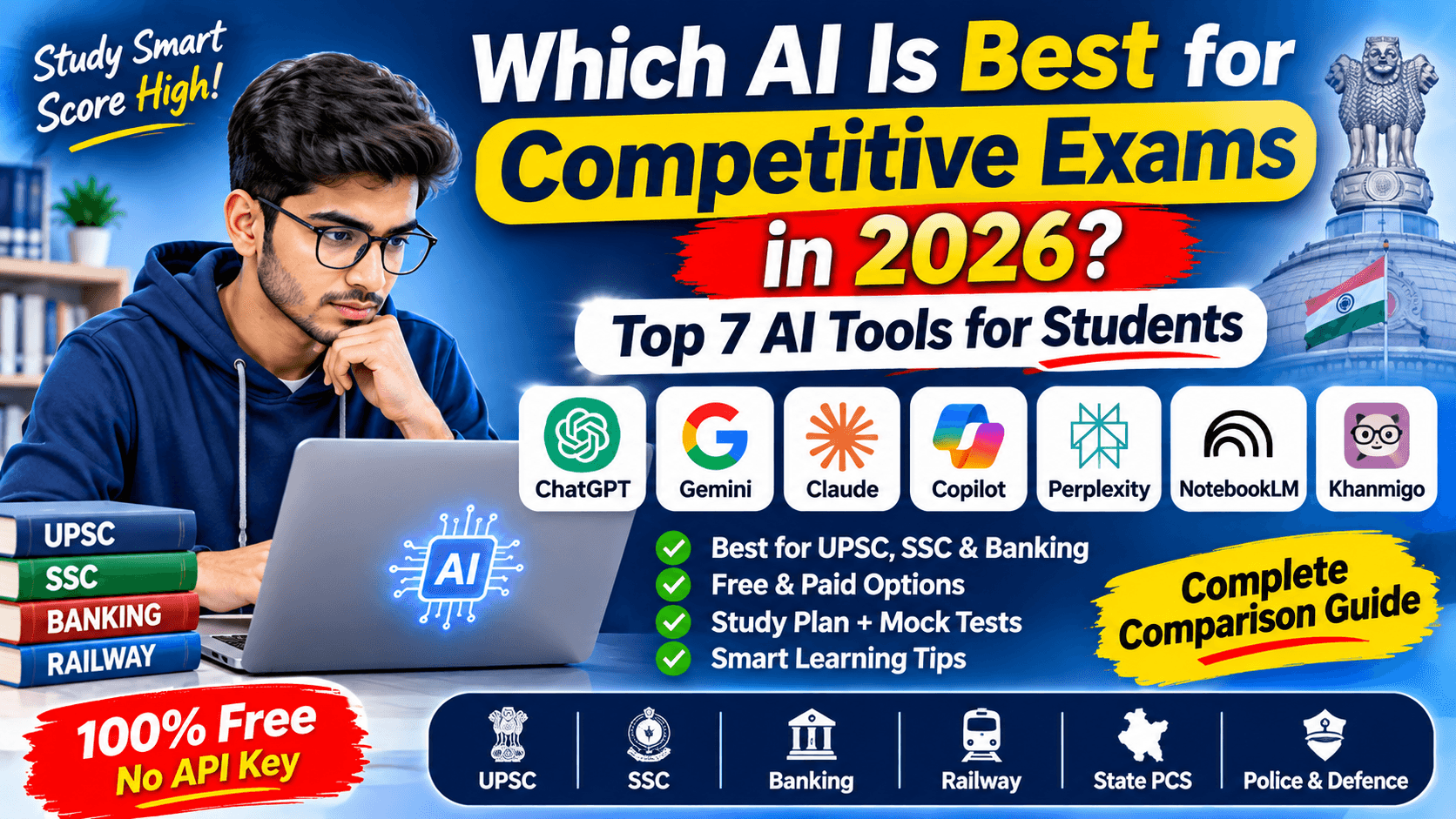
Which AI Is Best for Competitive Exams in 2026?
The best AI for competitive exams is the one that helps you understand, practise and review a topic without replacing the work that earns marks: reading the syllabus, solving questions yourself and checking facts against trusted material. UPSC, SSC, banking, railway, State PCS, police and defence exams reward different combinations of recall, speed, accuracy and written reasoning. One chatbot cannot be equally strong at every task.
This guide compares ChatGPT, Google Gemini, Claude, Microsoft Copilot, Perplexity, NotebookLM and Khanmigo for Indian aspirants. The recommendations focus on practical study workflows, not promotional rankings. AI services change their models, limits, features and prices often; free access can also vary by account, country and date. Check each official plan page before paying. Prices are therefore not treated as fixed promises here.
Short answer: start with one general assistant for explanations and practice, then add a source-grounded tool such as NotebookLM or Perplexity for research. Keep official notifications, NCERTs, standard books, previous-year papers and your own error log as the authority.
Quick comparison of seven AI study tools
| Tool | Best study use | Free and paid access | Hindi and documents |
|---|---|---|---|
| ChatGPT | Tutoring, question practice, feedback | Free access with limits; paid plans expand access and limits | Can respond in Hindi; file features depend on plan/limits |
| Gemini | Google-connected tasks and multimodal help | Free and paid Google AI plans; availability varies | Hindi support; document features vary |
| Claude | Long explanations, writing and document review | Free limited tier; Pro and higher paid plans | Hindi prompts work; confirm outputs; file limits vary |
| Copilot | Web-assisted answers and Microsoft workflows | Consumer access and paid Microsoft 365 options differ | Hindi conversation; connected document features depend on plan |
| Perplexity | Research leads with citations | Free searches and paid Pro tier; limits can change | Hindi queries; sources need checking |
| NotebookLM | Questions grounded in your supplied sources | Free access with usage limits; paid Google AI options may raise limits | Useful with uploaded source documents; language output varies |
| Khanmigo | Guided foundational tutoring | Learner access is region-restricted; verify eligibility | Not a reliable India-first exam-prep option |
“Free” does not mean unlimited, and a paid subscription does not make an answer authoritative. Read live terms before uploading sensitive notes or purchasing a plan.
Detailed reviews: which tool should you use?
ChatGPT — flexible tutor and practice partner. Ask it to explain a concept at two levels, generate original questions, critique a draft answer against a rubric, or turn your mistakes into a revision plan. File and image uploads are available across free and paid accounts subject to plan-specific limits, as described in the official upload guidance. Use it for UPSC answer-writing drills, SSC arithmetic explanations and banking reasoning practice. It can still invent facts, misread a question image or give a flawed calculation; solve first and verify after.
Google Gemini — multimodal help and Google workflows. Gemini can be useful when your study material includes text, screenshots or other supported inputs, and when you work with Google services. Google offers free access and paid Google AI plans, but model availability, caps and included features change; consult Google’s current plan page for your account and region. Ask it to explain a diagram or organize a study week, then check dates, schemes and exam notices against primary sources. Hindi questions are a useful option, though technical terminology should be cross-checked.
Claude — patient explanations and long-form review. Claude is suited to asking follow-up questions about a long passage, improving the structure of a mains answer, or converting your notes into a concise outline. Anthropic lists a limited free plan and paid plans; its pricing page shows current plan terms, which can differ by billing location. It is not a source of truth for current affairs. Give it the relevant official excerpt and ask it to distinguish what the text says from its own inference.
Microsoft Copilot — quick web help and Microsoft productivity. Copilot can help brainstorm explanations, summarize suitable material and support study workflows around Microsoft products. Consumer Copilot and Microsoft 365 Copilot are distinct offerings, so do not assume a feature available in one is included in another. Check Microsoft’s current Copilot plans for the latest availability. Use it for quick topic overviews and document tasks; inspect linked sources and verify exam-relevant facts independently.
Perplexity — research discovery, not final authority. Perplexity is useful when you need a starting list of sources for a current event, policy or report. Free and paid Pro access have different limits and features; check the official Pro page rather than relying on old price screenshots. Open the cited source, check its date and publisher, and prefer official releases such as PIB, RBI, ministries, Parliament, UPSC and state departments. A citation can be irrelevant or fail to support the sentence beside it.
NotebookLM — revision from a controlled source pack. Add syllabus documents, class notes, a selected NCERT chapter or official report, then ask questions tied to those sources. This makes it helpful for revision and comparing passages, but it cannot fill gaps in sources reliably. Check NotebookLM for current limits and supported source types. Keep your source pack small and labelled by date; do not mix unverified summaries with authoritative documents.
Khanmigo — useful tutoring idea, limited Indian access. A guided tutor that asks questions rather than simply giving answers can help build foundations. However, Khan Academy’s current learner sign-up guidance says learner/parent plans require a billing address in the United States or Washington, DC. See its eligibility requirements before planning around it. For most learners in India it is not the practical first choice; use Khan Academy’s accessible learning material where available, or ask another assistant to tutor Socratically.
Best AI for UPSC, SSC, banking and other exams
UPSC Civil Services: use ChatGPT or Claude for answer structure, counterarguments and plain-language explanations; use NotebookLM to interrogate a carefully selected set of NCERT, syllabus and official report documents. Use Perplexity to discover current-affairs sources, then read the sources directly. For mains, insist that feedback cite the question demand and your chosen rubric. AI cannot replace standard books, the official syllabus, newspaper judgment or your own synthesis.
SSC CGL/CHSL and Banking (IBPS/SBI): a general chatbot can show alternate approaches to arithmetic and reasoning, generate timed drills and explain why distractors are wrong. Ask for questions at a named level and topic, but use official or reputable previous-year papers to calibrate difficulty. For banking, practise data interpretation and speed under a timer; AI-generated questions may not match the current pattern.
Railway, State PCS, Police and Defence: use an assistant to build a syllabus checklist and create short revision quizzes for static GK, reasoning and quantitative basics. For state-specific history, laws, recruitment rules and current affairs, provide official state sources and verify every claim. Fitness, medical and eligibility requirements must come from the recruiting authority, not a chatbot.
CUET and other entrance tests: use AI to explain concepts, make flashcards from your own notes and diagnose recurring errors. Confirm subject combinations, dates, marking schemes and eligibility from the relevant official notice.
Which AI is best for current affairs, maths, reasoning and English?
Current affairs: Perplexity can help find reporting and primary documents; NotebookLM can help you revise a source pack. Neither guarantees completeness or accuracy. Use a date window, open the original publication and note the source beside every fact. The UPSC, PIB, RBI, Election Commission, ministries and relevant state departments are stronger references than a generated digest.
Mathematics and reasoning: ChatGPT, Gemini or Copilot can explain steps and generate practice. Make the assistant show intermediate work, then independently recompute. For a visual puzzle, verify that the image was transcribed correctly. Do not let an AI solve every question for you: first attempt it under exam conditions, then compare methods and record the mistake type.
English and General Studies: Claude or ChatGPT can give feedback on clarity, grammar, structure and evidence if you provide a rubric. For GS, ask for competing views and identify which claims need sources. Hindi is supported to varying degrees across tools; ask for bilingual explanations of technical terms, then preserve standard exam terminology. Translation can blur legal, constitutional or scientific meaning, so compare against textbooks.
Free AI tools for exam preparation: a sensible starter setup
You can begin without buying seven subscriptions. Choose one free general assistant for concept doubts and question generation, one source-oriented tool for research or your own documents, and a spreadsheet or notebook for the error log. Free tiers have usage caps, and some advanced models, research modes, storage or integrations may be paid. Avoid sharing personal data, login credentials, unpublished answer sheets or sensitive documents.
A practical routine is: (1) study the topic from a trusted source; (2) close the book and attempt recall; (3) ask AI to quiz you; (4) mark each response correct or incorrect using the source; (5) enter mistakes into a spaced revision list. This keeps the tool in a supporting role and makes improvement measurable.
ChatGPT vs Gemini vs Claude: how to choose
Choose ChatGPT if you want one adaptable study companion for drills, explanations and writing feedback. Choose Gemini if your workflow benefits from Google-connected tasks or multimodal inputs. Choose Claude if you frequently work through long notes and want structured writing feedback. These are practical starting points, not measured rankings: model versions and limits change, and performance depends on the prompt and task.
Try the same study task in two tools using the same source and rubric. Compare correctness, clarity, useful citations, Hindi terminology and how well each admits uncertainty. Keep the answer that can be checked—not simply the one that sounds most confident.
Create a daily study timetable with AI
Give the assistant your exam date, subjects, syllabus left, available hours, fixed commitments, weekly mock-test slot and rest needs. Ask for a realistic timetable with focused blocks, revision intervals and a buffer for missed sessions. Do not ask it to schedule every minute. Reserve the most alert hours for difficult work and include meals, sleep and breaks.
At day’s end, report what you completed and what took longer. Ask it to adjust tomorrow without deleting revision or mock analysis. Once a week compare the plan with actual work. A timetable is a hypothesis to refine, not a promise that a model can make you follow it.
10 ready-to-use AI prompts for competitive exam preparation
- 90-day UPSC plan: “Create a 90-day plan for [attempt/date]. My completed topics are [list], available hours are [hours]. Use the official syllabus I paste below, schedule revision and weekly tests, and flag assumptions.”
- SSC reasoning drill: “Write 25 original [topic] questions at SSC CGL level. Give questions first without answers. After I respond, score them and explain each error.”
- Maths in Hindi: “Teach [concept] in Hindi for a beginner preparing for [exam]. Show one solved example, then give three questions; do not reveal solutions until I try.”
- Banking mock: “Create a 20-question timed practice set on [topic] at [IBPS/SBI] level. Label it original practice, not a past paper. Provide an answer key and worked solutions separately.”
- PDF notes: “Using only the uploaded document, summarize [topic] into key claims, definitions, dates and page references. Mark unclear or absent information; do not add outside facts.”
- Revision notes: “Turn my notes below into a one-page revision sheet with headings, definitions and 10 active-recall questions. Preserve facts and mark anything ambiguous for checking.”
- Current-affairs quiz: “Using these official links and dates only, make 10 questions about [date range]. Cite the source for each answer and distinguish fact from analysis.”
- NCERT concept: “Explain [chapter/concept] from this supplied NCERT excerpt at [exam] level. Give a simple analogy, key terms and five recall questions; cite the passage.”
- Weak-subject analysis: “Here is my last four test score breakdown and error log. Group mistakes by concept, speed, calculation and misreading; suggest a one-week practice plan without predicting my result.”
- Weekly revision: “Build a seven-day revision timetable from these topics, test dates and available hours. Use spaced review, one mock-analysis block and realistic buffers.”
Advantages and disadvantages of AI for government exam preparation
Advantages: instant re-explanations at different levels; low-friction question generation; feedback on written structure; help organizing notes and revision; and a patient way to practise asking questions. Used well, these can increase active recall and help a student notice gaps sooner.
Disadvantages: hallucinated facts and citations; outdated current affairs; incorrect arithmetic or reasoning; generated questions unlike the real exam; overconfident writing feedback; privacy concerns; and passive dependence that weakens recall. Paid features can also change or be region-limited. An AI answer is not evidence that you have mastered a topic.
Common mistakes students should avoid
Do not ask AI to summarize a whole syllabus and treat that as preparation. Do not memorize an answer before checking its source. Do not accept a citation without opening it. Do not use generated MCQs as a substitute for previous-year papers. Do not request a “guaranteed selection plan”; no tool can guarantee an outcome. Avoid entering private information, and do not use AI during a closed-book mock if the goal is to measure your independent ability.
A better habit is to ask for hints before solutions, answer first, verify afterward and keep an error log. If two tools disagree, resolve the point through a textbook or official source rather than voting for the more persuasive response.
Frequently asked questions
Which is the best AI for UPSC preparation? There is no universal winner. Combine a general tutor for writing and explanations with source-grounded document study, while validating claims using the syllabus and primary sources.
Can AI prepare me for SSC or banking exams? It can support concept learning and extra practice, but use current official notices and authentic previous-year papers to learn the exam pattern and difficulty.
Which AI gives the most accurate current affairs? No chatbot should be treated as fully accurate. Use it to locate sources and create revision questions, then verify the source date and wording yourself.
Can I use these tools in Hindi? Most can accept Hindi prompts or provide Hindi responses to varying degrees. Check specialist terminology against trusted bilingual material.
Is Khanmigo available to students in India? Khan Academy’s learner-plan requirements currently specify a US billing address, so Indian learners should verify eligibility directly and not assume access.
Do free AI plans include PDF analysis? Capabilities and usage limits differ by product and change over time. Check current official documentation before relying on a particular upload feature.
Will AI guarantee exam success? No. Selection depends on many factors, including preparation, performance and available seats. AI is a study aid, not a guarantee.
Final recommendation: choose a tool for the task
For most Indian aspirants, begin with a free general AI assistant for explanations and practice, then add NotebookLM for a controlled source pack or Perplexity for research discovery if those workflows genuinely help. ChatGPT, Gemini and Claude are reasonable all-round choices; your best fit depends on access, language needs, limits and how accurately the tool handles your own sample tasks. Khanmigo may be useful as a tutor conceptually, but its learner eligibility makes it a poor default recommendation for India.
Use AI to ask better questions, practise retrieval and review mistakes. Use official exam notifications, standard books, NCERTs and previous-year papers to decide what is true and what matters. The final responsibility for every fact in your notes and answer remains yours.
Further reading and official tools
Read our existing guide to AI tools for competitive exam preparation for a broader study-tool overview. You may also find our SSC CGL AI tools guide and UPSC aspirant tools guide useful.
Official product information: ChatGPT, Gemini, Claude, Copilot, Perplexity, NotebookLM, and Khanmigo eligibility.