What AI Can and Cannot Do for Speaking Practice

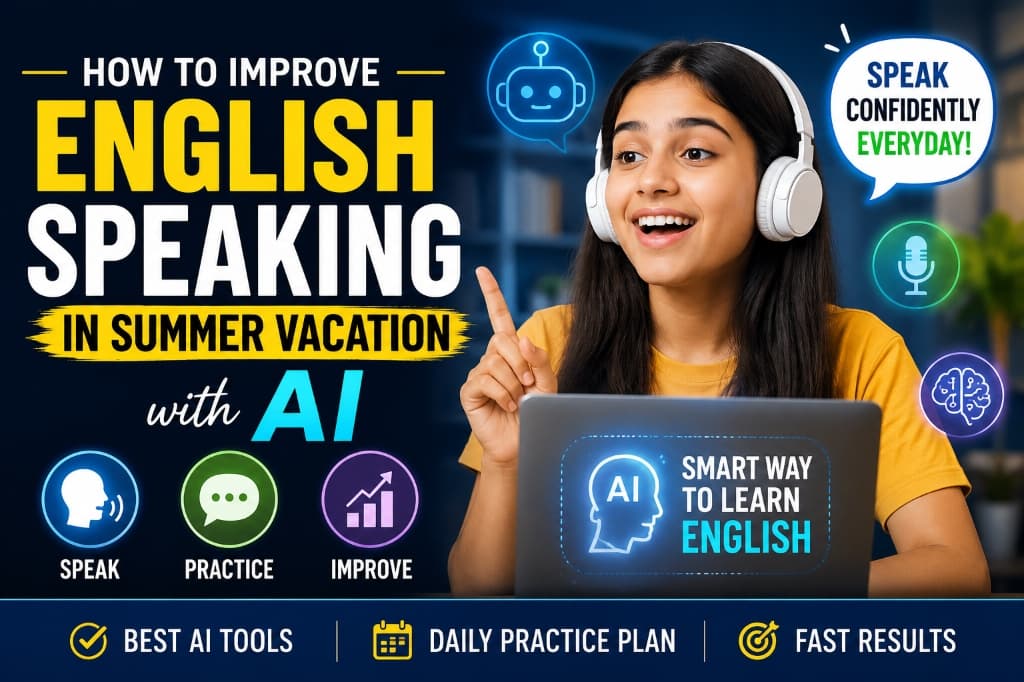
A school break or quieter work period can make room for regular speaking practice. A voice-enabled AI tool can provide short role-plays and follow-up questions when a conversation partner is not available. It is a practice aid, not a guaranteed route to fluency or a replacement for lessons, listening, reading, and conversations with people.
This guide gives you a four-week routine that works with any conversational tool whose voice feature is available to you. It focuses on speaking in complete thoughts, noticing a small number of recurring errors, and trying a corrected version again. You do not need a particular accent or a paid app to use the routine.

Set Up a Practice Session

Choose a topic you can talk about without researching first: a daily routine, a favourite subject, a recent film, or a simple plan. Open the voice or conversation feature in your chosen tool if it is available. Interfaces, supported languages, access, and usage limits can vary by app, account, device, and region, so check the provider's current help pages rather than relying on old setup instructions.
For an example of how to check current product information, see the official OpenAI Voice Mode FAQ and Google Gemini mobile app availability and requirements. You can also practise without a voice feature: speak aloud, then paste your own transcript for feedback.

A 15-Minute Session You Can Repeat

  1. Choose one goal (2 minutes): For example, explain a process clearly or answer a follow-up question without switching topics.
  2. Speak (8 minutes): Have a short conversation or role-play. Ask the tool to let you finish before it responds.
  3. Review (3 minutes): Ask for up to three corrections from the conversation. Focus on repeated grammar, word choice, or unclear phrasing rather than every small mistake.
  4. Try again (2 minutes): Answer one similar question using the feedback, without reading a prepared script.
If you only have five minutes, keep the same order: speak briefly, choose one correction, and repeat the thought. A short session that you can sustain is more useful than a long session that you quickly abandon.

A Four-Week Summer-Break Practice Plan

Before the first week: Record or speak a one-minute answer to a familiar question, such as What do you like learning about? Note where you paused, which words you wanted, and whether your main point was clear. Treat this as a personal reference, not a test score. Only record yourself if you are comfortable storing the audio.

  • Week 1 - familiar topics: Practise introductions, daily routines, hobbies, and describing familiar places. Work on answering in two or three connected sentences.
  • Week 2 - telling a story: Describe a recent event in order: what happened, what you did, and what you learned. Ask the AI to request one missing detail instead of rewriting your story.
  • Week 3 - practical role-plays: Practise situations relevant to you, such as asking a teacher for clarification, making an appointment, or explaining a project. Repeat the same scenario with one detail changed.
  • Week 4 - flexible responses: Mix familiar and new topics. Answer a follow-up question, then repeat one earlier prompt and compare clarity, pauses, and the corrections you still make.
Try the routine on several days each week and leave room for listening to real speakers and speaking with people when possible. The schedule is a structure for practice, not a promise that a particular level of fluency will be reached in four weeks.

Copy-Ready Prompts for Speaking Practice

AI Prompt Box

Use for: a short, low-pressure conversation. Replace the topic with one you want to practise. Input: a topic and your approximate level. Expected output: one question at a time, followed by a brief review.

Act as a patient English conversation partner. My level is [beginner/intermediate/advanced], and I want to practise [topic]. Ask one short question at a time and wait for my answer. Do not complete my sentences. After about five exchanges, identify up to three useful corrections from what I said. Quote my original phrase, suggest a natural alternative, and explain the change in simple English. If you are unsure what I said, ask me to repeat instead of guessing.

Use for: practising a situation you may actually encounter. Input: your role, the other person's role, and the situation. Expected output: a back-and-forth role-play and a few phrases to practise again.

Let's role-play [situation]. I am [my role] and you are [other role]. Keep the conversation realistic and ask one question at a time. Let me finish my answer before replying. Do not interrupt to correct me. When we finish, show up to three phrases I could say more clearly and ask me to repeat the conversation with one detail changed.

Use for: reviewing a transcript when voice chat is unavailable or speech recognition produced text. Input: a transcript you are comfortable sharing. Expected output: a small set of corrections and a follow-up speaking task.

Review this English practice transcript: [paste transcript]. First, tell me if any phrase may be a speech-recognition error and ask me to confirm it. Then choose up to three corrections that matter most for clarity. For each, show my phrase, a clearer alternative, and a short explanation. Do not rewrite the whole answer. Finish with one related question for me to answer aloud.

Output Example — Prompt 1

Author upload required: add a real output for Prompt 1, describe what is visible, and record the tool and version used.

Tool: Author must supply · Version: Author must supply
Placeholder — no real output has been uploaded and documented yet.

Track Progress Without Chasing a Perfect Accent

After each session, write down the date, topic, minutes spent speaking, one thing that was clear, and one pattern to revisit. Examples of useful patterns include past-tense endings, articles such as a and the, or pausing to find a word. At the end of the week, choose one pattern for the next few sessions instead of trying to fix everything at once.
The goal is understandable communication, not imitating a particular accent. AI transcripts can omit or mishear words, and automated pronunciation advice may not fit your speech or variety of English. Check uncertain feedback with a teacher, trusted speaker, dictionary audio, or another reliable learning resource. If possible, include real conversations so you practise listening and responding to different people.

Limits, Privacy, and Healthy Practice

An AI conversation can be convenient, but it may misunderstand speech, offer a correction that changes your meaning, or favour a formal phrase that does not sound natural in context. Ask it to explain why a correction helps, keep examples you trust, and ignore suggestions that you cannot verify.
Do not enter private information, passwords, or sensitive details into a practice chat. Check the service's current privacy and audio-data settings before using recordings, and do not record another person without their consent. Keep practice manageable; if a voice interface is frustrating or unavailable, read a short passage aloud, shadow a public audio clip, or practise with a person instead.

Frequently Asked Questions (FAQs)

Q: Do I need a paid AI plan to practise speaking? - A: No particular plan is required for the exercises in this guide. You can speak aloud and review your own transcript; voice features and their limits vary, so check the provider's current terms.
Q: Can AI tell me exactly how to improve my pronunciation? - A: Treat automated feedback as a suggestion. Speech recognition can mishear words, and pronunciation feedback may not reflect your intended meaning or preferred variety of English.
Q: Will this plan make me fluent in four weeks? - A: No timeline or outcome can be guaranteed. The four-week structure is a way to practise regularly and review specific habits; progress depends on your starting point, practice, and opportunities to use English.
Q: Should the AI correct every mistake while I am speaking? - A: Usually not. Ask it to wait until you finish and select a few corrections that affect clarity or recur often, so you can keep the conversation going.
Q: Is practising with AI enough on its own? - A: It can help you rehearse, but it does not replace listening to real speakers or having conversations with people. Combine different kinds of practice when you can.
Q: Is it safe to upload a voice recording? - A: Review the tool's current privacy and audio-data settings first. Avoid sharing sensitive details, and do not upload another person's voice without permission.