Quick Answer: What Is the Best Way to Use AI for Government Exams?
Introduction: Where AI Helps—and Where It Does Not
How This Guide Was Prepared
Before Opening an AI Tool: Build a Reliable Source Pack
How to Use AI for Government Exam Preparation: 12-Step Workflow
- Understand the syllabus: compare the official syllabus with previous-year papers and create a topic checklist.
- Create a realistic plan: allocate time according to exam weight, weakness and days available—not an arbitrary internet timetable.
- Break down large topics: convert broad units into concepts that fit focused study sessions.
- Learn from standard sources: read the book or official material before asking AI to clarify a doubt.
- Generate revision notes: compress your verified notes into definitions, formulas, timelines and recall questions.
- Practise MCQs: use previous-year questions first; use generated questions only as supplementary practice.
- Analyse wrong answers: label each error as knowledge, concept, calculation, misreading, guessing or time pressure.
- Create flashcards: make short, single-idea cards from facts you have verified.
- Practise descriptive answers: request feedback on relevance, structure and missing dimensions; keep your own reasoning.
- Revise current affairs: use dated primary sources and connect news with the static syllabus.
- Rehearse interviews: practise concise answers and follow-ups without inventing personal details.
- Review weekly and revise finally: compare planned versus completed work, update the error log and prioritise high-value revision.
A Practical Weekly Hybrid Routine
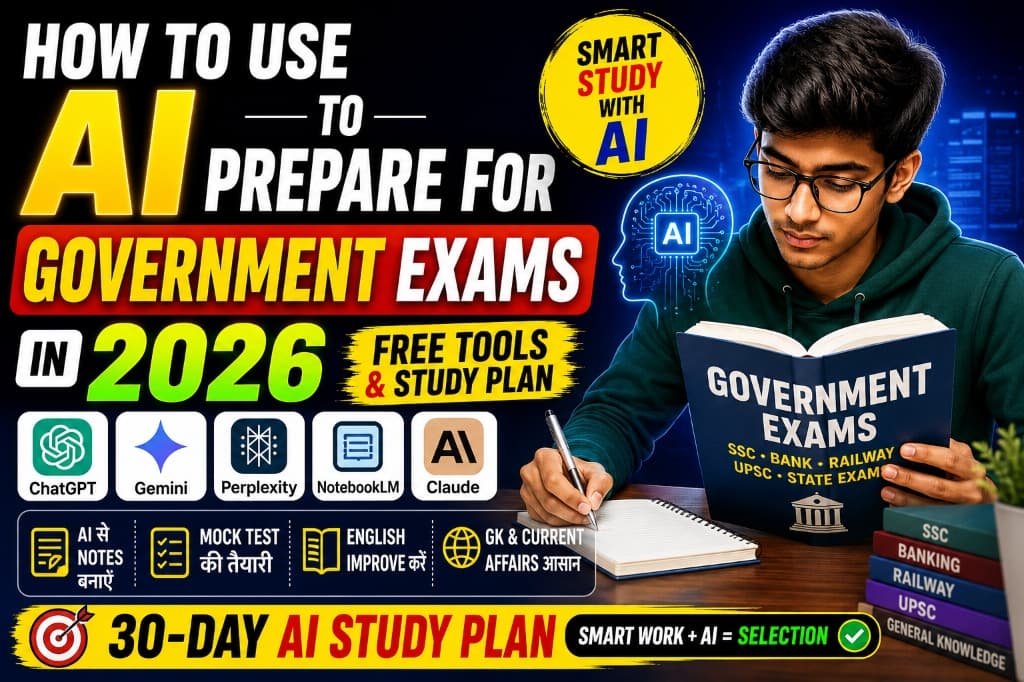
AI Tools for Competitive-Exam Study Tasks
| Tool | Best suited to | Useful study tasks | Free option | Key limitation |
|---|---|---|---|---|
| ChatGPT | Interactive explanation | Socratic tutoring, quizzes, answer feedback and planning | Access is available across plans; limits vary | Can make mistakes; verify exam facts |
| Gemini | Working with supported files | Summaries, comparisons and questions about uploaded material | Limited access may be available | Limits and account requirements vary |
| NotebookLM | Source-grounded study | Study guides, briefings, mind maps and source-linked questions | Access available with eligible Google accounts | Quality depends on uploaded sources |
| Claude | Long-form drafting and critique | Essay outlines, explanations and revision of your draft | Availability and limits vary | Generated citations and facts require checking |
| Perplexity | Web research with source links | Finding primary sources and building a current-affairs reading list | Limited access may be available | A citation does not prove the summary is correct |
Syllabus Analysis Templates
Prompt 1 — Syllabus map
I am preparing for [EXAM AND STAGE]. Below is the exact syllabus copied from the latest official notification. Convert it into a hierarchical checklist of subjects, units and subtopics. Preserve the wording of every syllabus item, mark anything ambiguous, and do not add topics unless you label them as a suggested prerequisite. Output columns: syllabus wording, subtopics, prerequisite, suggested source type and completion status. Syllabus: [PASTE].Prompt 2 — Syllabus-to-PYQ map
Using only the syllabus and previous-year questions I provide, map each question to the closest official syllabus unit. Count questions by unit and year, identify recurring concepts, and list questions that do not map cleanly. Do not predict future questions or call a topic high priority without evidence in the supplied papers. Syllabus: [PASTE]. Questions with years: [PASTE].Output Example — Prompt 1
Tool: Author must supply · Version: Author must supply
Output Example — Prompt 2
Tool: Author must supply · Version: Author must supply
Study Plan Templates
Prompt 3 — Attempt plan
Create a realistic [NUMBER]-week plan for [EXAM/STAGE]. I can study [HOURS] on weekdays and [HOURS] on weekends. My strong subjects are [LIST], weak subjects are [LIST], and fixed commitments are [LIST]. Use the official syllabus pasted below. Include learning, previous-year questions, spaced revision, one buffer block and weekly tests. Do not promise completion if the hours are insufficient; instead show what to reduce. Syllabus: [PASTE].Prompt 4 — Backlog recovery
My exam is on [DATE OR UNKNOWN], and I am behind in [TOPICS]. I have [HOURS] hours per week. Build a two-week recovery plan that prioritises prerequisites and exam relevance. Separate must-do, should-do and optional work. Include a daily stopping point, revision slots and a method to decide whether I should continue a difficult topic or move on. Do not invent exam weightage.Output Example — Prompt 3
Tool: Author must supply · Version: Author must supply
Output Example — Prompt 4
Tool: Author must supply · Version: Author must supply
Daily Study Schedule Templates
Prompt 5 — Time-blocked day
Design today's schedule for [EXAM] from [START TIME] to [END TIME]. Tasks: [LIST]. My concentration is strongest at [TIME], and I need breaks at [CONSTRAINTS]. Place concept learning before related practice, use 45–90 minute blocks, add 10-minute active-recall reviews, and include one buffer block. Output a table with time, task, measurable finish condition and source.Prompt 6 — Low-energy day
Create a minimum-viable study schedule for a low-energy day. I have [TIME] and must keep continuity in [SUBJECTS]. Prioritise one revision task, one short practice set and error-log review. Avoid adding new large topics. End with a five-minute plan for tomorrow and define what counts as a completed day.Output Example — Prompt 5
Tool: Author must supply · Version: Author must supply
Output Example — Prompt 6
Tool: Author must supply · Version: Author must supply
Topic Explanation Templates
Prompt 7 — Layered explanation
Teach me [TOPIC] for [EXAM/STAGE] in three layers: (1) a 100-word intuition, (2) a precise exam-level explanation, and (3) one worked example. Use only the source text below. Quote or point to the relevant source passage for important claims, distinguish fact from analogy, and ask me three diagnostic questions before giving the final recap. Source: [PASTE].Prompt 8 — Compare confusing concepts
I confuse [CONCEPT A] with [CONCEPT B]. Create a comparison using definition, purpose, governing rule/formula, key differences, one example, one non-example and common exam traps. Base the answer on [SOURCE/CHAPTER]. If the source does not resolve a point, say 'not established by the supplied source' rather than guessing.Output Example — Prompt 7
Tool: Author must supply · Version: Author must supply
Output Example — Prompt 8
Tool: Author must supply · Version: Author must supply
Revision Notes Templates
Prompt 9 — One-page revision sheet
Convert my verified notes on [TOPIC] into a one-page revision sheet. Include only: five core ideas, essential terms, dates/formulas where present, a cause-effect chain, three common confusions and five active-recall questions. Preserve source page references. Do not introduce outside facts. Notes: [PASTE].Prompt 10 — Revision ladder
Create a revision ladder for [TOPIC] using my notes: a 10-minute review, a 30-minute review and a 60-minute review. Each level should specify what to recall without looking, what to check in the source and what questions to solve. Add suggested review intervals, but let me adjust them based on performance. Notes: [PASTE].Output Example — Prompt 9
Tool: Author must supply · Version: Author must supply
Output Example — Prompt 10
Tool: Author must supply · Version: Author must supply
MCQ Practice Templates
Prompt 11 — Source-based MCQ set
From the supplied verified material, create 12 single-correct MCQs for [EXAM] on [TOPIC]: 4 basic, 5 application and 3 elimination-based. Give four plausible options, but withhold answers until I respond. After my attempt, provide the key, source passage/page, explanation, why each distractor is wrong and whether any question is ambiguous. Source: [PASTE].Prompt 12 — Adaptive quiz
Quiz me on [TOPIC] one question at a time. Start at moderate difficulty. After each response, ask for my confidence from 1–5, explain using the supplied source, and adjust the next question based on correctness and confidence. Stop after 10 questions and summarise mastery by subtopic. Do not use facts outside this source: [PASTE].Output Example — Prompt 11
Tool: Author must supply · Version: Author must supply
Output Example — Prompt 12
Tool: Author must supply · Version: Author must supply
Wrong Answer Analysis Templates
Prompt 13 — Error classifier
Analyse my attempted questions below. For each wrong or guessed answer, classify the primary cause as knowledge gap, conceptual confusion, calculation, question misread, poor elimination, risky guess or time pressure. Explain the smallest corrective action and create one follow-up question. Use the official key I provide; flag any disagreement instead of overriding it. Attempts and confidence: [PASTE]. Official key/explanation: [PASTE].Prompt 14 — Error-log review
Here is my four-week error log. Group repeated errors by subject and cause, identify the three patterns costing the most marks, and propose a seven-day correction plan with measurable drills. Separate evidence from inference. Do not recommend more study hours until you first show how current time is being lost. Log: [PASTE].Output Example — Prompt 13
Tool: Author must supply · Version: Author must supply
Output Example — Prompt 14
Tool: Author must supply · Version: Author must supply
Flashcard Templates
Prompt 15 — Atomic flashcards
Turn the verified notes below into up to 25 atomic flashcards. Each card must test one idea only, have a short question and a concise answer, and retain the source page. Include a mix of direct recall, cloze deletion and concept discrimination. Exclude trivia not present in the notes. Notes: [PASTE].Prompt 16 — Difficult-card repair
These flashcards repeatedly fail in review: [PASTE]. Diagnose whether each card is too broad, ambiguous, overloaded or missing context. Rewrite it into one or more atomic cards without changing the verified fact. Add a brief mnemonic only when it does not distort the meaning.Output Example — Prompt 15
Tool: Author must supply · Version: Author must supply
Output Example — Prompt 16
Tool: Author must supply · Version: Author must supply
Current Affairs Templates
Prompt 17 — Primary-source brief
Create an exam-oriented brief from this dated primary source. Include event, institution, date, decision, relevant static-syllabus link, terms that require verification and five recall questions. Clearly separate what the document states from background context. Do not add a current office-holder or statistic unless it appears in the source. Source title, date and text: [PASTE].Prompt 18 — Weekly current-affairs revision
Using only the verified briefs I paste, organise this week's current affairs under polity, economy, environment, science, international relations and other relevant syllabus areas. Merge duplicates, retain dates and source URLs, create ten revision questions and list items that may have changed since publication. Briefs: [PASTE].Output Example — Prompt 17
Tool: Author must supply · Version: Author must supply
Output Example — Prompt 18
Tool: Author must supply · Version: Author must supply
Mains Answer-Writing Templates
Prompt 19 — Answer evaluator
Evaluate my [WORD LIMIT]-word answer to this [EXAM] question. Do not rewrite it immediately. First assess demand of the question, relevance, structure, balance, evidence, missing dimensions, clarity and conclusion. Quote short phrases from my answer as evidence, give a score only against the rubric I provide, and propose a 15-minute improvement exercise. Question: [PASTE]. Rubric: [PASTE]. Answer: [PASTE].Prompt 20 — Outline before writing
Help me plan—not write—a [WORD LIMIT]-word answer to [QUESTION]. Identify directive words, scope, necessary definitions, 4–6 dimensions, counterpoint and conclusion direction. For every factual example, ask me to verify it from my sources. Then wait for my outline and critique it before showing a model structure.Output Example — Prompt 19
Tool: Author must supply · Version: Author must supply
Output Example — Prompt 20
Tool: Author must supply · Version: Author must supply
Essay Practice Templates
Prompt 21 — Essay idea matrix
For the essay topic [TOPIC], build an idea matrix across social, ethical, constitutional, economic, historical, scientific, environmental and personal dimensions where relevant. Mark weak or forced dimensions. Suggest questions that help me develop my own thesis; do not fabricate quotations, statistics or anecdotes. End with three possible thesis positions, including one nuanced position.Prompt 22 — Coherence review
Review my essay for thesis consistency, paragraph purpose, transitions, repetition, counterargument and conclusion. Do not replace my voice. Produce a reverse outline showing the function of each paragraph, identify unsupported claims that need sources, and recommend the five highest-impact edits. Essay: [PASTE].Output Example — Prompt 21
Tool: Author must supply · Version: Author must supply
Output Example — Prompt 22
Tool: Author must supply · Version: Author must supply
Previous-Year Question Analysis Templates
Prompt 23 — PYQ pattern audit
Analyse only these previous-year questions from [EXAM, STAGE, YEARS]. Tag each by official syllabus unit, concept, task type and difficulty reason. Show frequency counts and repeated concepts, but explain that past frequency does not guarantee future weightage. Flag incomplete questions or missing diagrams. Questions: [PASTE]. Syllabus: [PASTE].Prompt 24 — PYQ learning plan
Based on my PYQ performance table, create a two-week learning plan. Prioritise recurring conceptual weaknesses over isolated careless errors, include re-attempt dates and specify which standard source chapter I should revisit from the mapping I provide. Do not infer topic importance beyond supplied PYQs and syllabus. Performance: [PASTE]. Mapping: [PASTE].Output Example — Prompt 23
Tool: Author must supply · Version: Author must supply
Output Example — Prompt 24
Tool: Author must supply · Version: Author must supply
Mock Test Templates
Prompt 25 — Mock analysis
Analyse my timed mock for [EXAM/STAGE]. Inputs include section, question status, correctness, time, confidence and official key. Calculate attempted, correct, incorrect, unattempted and accuracy; apply negative marking only using the rule I provide. Identify time sinks, lucky guesses and avoidable errors. Give three changes for the next mock. Data: [PASTE]. Marking rule: [PASTE].Prompt 26 — Test strategy simulation
Using the section rules and my last three mock summaries, compare two attempt strategies for [EXAM]. Respect sectional timing/cut-offs only if supplied. Estimate trade-offs without predicting selection. Design a small experiment for my next two mocks so I can compare accuracy, attempts and time objectively. Rules: [PASTE]. Summaries: [PASTE].Output Example — Prompt 25
Tool: Author must supply · Version: Author must supply
Output Example — Prompt 26
Tool: Author must supply · Version: Author must supply
Interview Preparation Templates
Prompt 27 — Structured mock interview
Conduct a mock interview for [EXAM/ROLE]. Use only my non-sensitive profile summary and the official role description. Ask one question at a time, include respectful follow-ups, and assess clarity, relevance, honesty and composure—not accent. Challenge vague claims and never invent achievements for me. Profile: [PASTE]. Role/board guidance: [PASTE].Prompt 28 — Answer refinement
Help me improve this interview answer while preserving truthful content and my natural voice. Identify the direct question, unnecessary detail, unsupported claim and missing example. Suggest a 45–60 second structure, then ask me to record a new version. Do not add facts or experiences I did not provide. Question and answer: [PASTE].Output Example — Prompt 27
Tool: Author must supply · Version: Author must supply
Output Example — Prompt 28
Tool: Author must supply · Version: Author must supply
Weak-Area Analysis Templates
Prompt 29 — Diagnostic analysis
Use my last [NUMBER] tests to identify weak areas. Distinguish low accuracy caused by insufficient knowledge from low attempts, slow speed and careless mistakes. Require at least [MINIMUM QUESTIONS] observations before calling a topic weak; label smaller samples 'insufficient evidence.' Output evidence, diagnosis, next action and retest date. Data: [PASTE].Prompt 30 — Weekly review coach
Run my weekly review using this data: planned hours, completed topics, revision completed, question accuracy, mock score, sleep constraints and error log. Ask up to five clarifying questions, then recommend what to continue, stop and change next week. Keep the plan within my available hours and do not equate longer study time with better preparation. Data: [PASTE].Output Example — Prompt 29
Tool: Author must supply · Version: Author must supply
Output Example — Prompt 30
Tool: Author must supply · Version: Author must supply
Exam-Specific Adaptation: UPSC, SSC, Banking, Railway and Others
AI vs Traditional Study: Use a Hybrid System
Limitations of Using AI for Government Exam Preparation
- Incorrect facts: fluent answers may contain wrong dates, provisions, formulas or explanations.
- Outdated current affairs: an answer may miss a correction, later judgment or new appointment.
- Exam mismatch: the model may confuse stages, posts, syllabi or marking rules.
- Faulty practice: generated MCQs can have multiple valid answers, poor distractors or a wrong key.
- False citations: a title, link or quotation can be invented or misrepresented.
- Over-dependence: reading generated summaries can create familiarity without recall.
- Privacy and copyright: uploads may include material you do not have permission to share or personal data you do not need to disclose.
Official Sources Every Aspirant Should Bookmark
Frequently Asked Questions
A: Not automatically. AI can explain, quiz and organise study, while coaching may provide curriculum, feedback and accountability. Decide according to your exam, baseline and ability to verify mistakes.
A: Yes, it can draft one when you provide the official syllabus, exam date, available hours and current level. Review the plan for realistic workload and update it using actual weekly performance.
A: It can summarise a dated source and connect it to syllabus themes. Current information changes, so verify facts through primary documents and the latest official update.
A: No. AI can provide confident but incorrect facts, calculations, citations or answer keys. Important information must be checked independently.
A: Compare it with the official notification, prescribed textbook, standard reference, official answer key or primary document. Record the source and page for facts you plan to revise.
A: Yes, as supplementary practice from verified source material. Inspect ambiguity, options and key before adding generated questions to your permanent notes.
A: It can analyse question demand, structure and missing dimensions and critique your draft. You should still develop the argument, verify examples and write timed answers independently.
A: Choose by task: an interactive tutor for explanations, a source-grounded notebook for your materials, or a web research tool for finding primary sources. Current features and limits should be checked on official product pages.
A: Yes, if you provide complete questions, years and the official syllabus. Treat frequency as historical evidence, not a prediction of the next paper.
A: It can ask follow-ups and help make answers concise. Keep every claim truthful, avoid sharing sensitive data and seek human feedback for role-specific nuance and body language.