1. Introduction
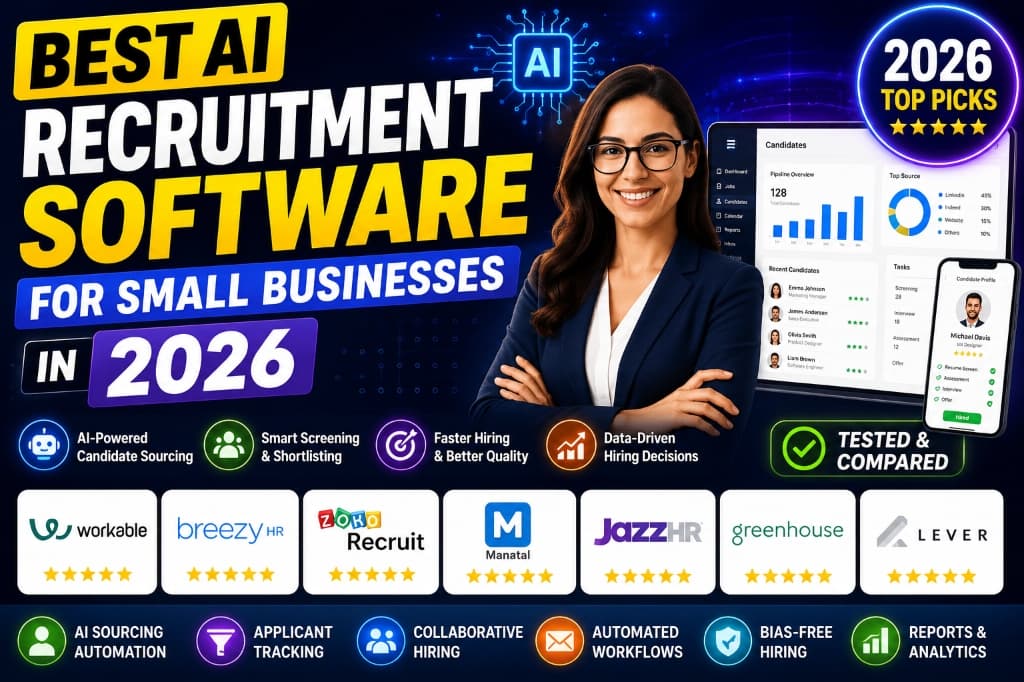
Finding the best AI recruiting software for small businesses is no longer a luxury — it is a competitive necessity. This guide compares seven leading platforms — Workable, Breezy HR, Zoho Recruit, Manatal, JazzHR, Greenhouse, and Lever — based on AI capabilities, applicant tracking features, ease of setup, pricing, and suitability for small teams. Whether you are a solo recruiter, a startup, or a growing company making 10–50 hires per year, this comparison will help you choose the right AI hiring tool and build a faster, more structured recruiting process.
Small businesses face unique recruiting challenges: limited HR staff, tight budgets, and the need for tools that work out of the box without enterprise-level configuration. AI recruiting platforms solve these problems by automating resume screening, syndicating job listings to multiple boards, scheduling interviews, and surfacing the best candidates from a large applicant pool — all without requiring a dedicated recruitment team. For managing employee records and HR workflows after hiring, see our guide on the Best AI HRIS Software for Small Businesses in 2026.
2. Quick Answer: What Is the Best AI Recruiting Software for Small Businesses?
There is no single best tool for every small business. The right recruiting software depends on your team size, hiring volume, and workflow. Here is a quick use-case guide based on the tools reviewed in this article:
- Best overall: Workable — full ATS plus AI candidate sourcing in one platform
- Best for very small teams: Breezy HR — visual drag-and-drop boards with a generous free plan
- Best for automation: Workable — AI sourcing, automated email outreach, and interview scheduling
- Best for budget-conscious businesses: Manatal — affordable per-user pricing starting at $15/user/month
- Best for Zoho users: Zoho Recruit — seamless sync with Zoho CRM and Zoho People
- Best for growing companies: Greenhouse — structured interview scorecards and enterprise-scale analytics
- Best for candidate relationship management: Lever — combines ATS with CRM-style passive candidate nurturing
3. Best AI Recruiting Software for Small Businesses: Quick Comparison
The table below compares the seven platforms across the criteria most important for small business hiring teams. Note: Pricing and plan details may change. Always verify current pricing on each vendor's website before purchasing.
| Software | Best For | Starting Price | Free Plan / Trial | ATS Included | Key AI Features | Our Verdict |
|---|---|---|---|---|---|---|
| Workable | All-in-one AI sourcing | $149/mo | 15-day trial | Yes | AI candidate search, resume parsing, job description writer | Best overall for active candidate sourcing |
| Breezy HR | Visual kanban pipelines | Free / $189/mo | Free plan available | Yes | AI screening assistant, automated candidate messaging | Best for very small teams and first-time ATS users |
| Zoho Recruit | Zoho ecosystem users | $30/user/mo | Free tier available | Yes | AI candidate matching, 75+ job board syndication | Best for businesses already on Zoho |
| Manatal | Budget-friendly ATS | $15/user/mo | 14-day trial | Yes | AI profile enrichment, social media data parsing | Best for cost-conscious small businesses |
| JazzHR | Collaborative hiring boards | $75/mo flat rate | 21-day trial | Yes | Resume keyword screening, job board syndication | Best for multi-manager collaborative hiring |
| Greenhouse | Structured enterprise hiring | Contact sales | Demo only | Yes | Predictive hiring forecasts, structured scorecard templates | Best for fast-growing companies scaling hiring |
| Lever | Candidate relationship nurturing | Contact sales | Demo only | Yes | AI email drip campaigns, unified CRM + ATS pipeline | Best for nurturing passive candidates |
4. Why Small Businesses Need AI-Powered Recruiting
Hiring the wrong person costs a small business far more than a missed deal — it disrupts team dynamics, slows growth, and wastes weeks of onboarding time. AI recruiting software addresses this by automating the repetitive parts of hiring: parsing hundreds of resumes in seconds, scoring candidates against job criteria objectively, syndicating job listings to dozens of boards simultaneously, and auto-scheduling interviews without manual back-and-forth. This means a team of two can run a hiring process that previously required a full HR department.
For small businesses without a dedicated recruiter, AI tools also reduce unconscious bias by evaluating candidates against consistent, predefined criteria rather than gut feel. Platforms like Greenhouse introduce structured interview scorecards, ensuring all candidates are assessed the same way. Meanwhile, tools like Breezy HR and Workable automate candidate communications, so applicants receive timely updates without manual follow-up — which directly improves the candidate experience and your employer brand.
Beyond speed, AI recruiting platforms provide data visibility. Instead of losing track of where candidates are in your pipeline, a modern ATS gives your team a real-time dashboard showing every open role, candidate stage, and next action required. For building the full HR system after hiring is done, see our comparison of the Best AI HR Software in 2026.
5. AI Recruiting Statistics: What the Data Shows in 2026
To put the impact of recruiting automation in context, here are key trends shaping how small businesses hire in 2026:
- Faster screening: AI resume parsing significantly reduces initial candidate screening time, allowing small teams to process large applicant pools efficiently.
- Time-to-hire improvements: Automated interview scheduling reduces scheduling friction, shortening the time from first contact to offer acceptance.
- Job board reach: Platforms like Zoho Recruit syndicate listings to 75+ boards simultaneously, dramatically increasing application volume without extra posting costs.
- Candidate drop-off reduction: Automated candidate status emails reduce application abandonment by keeping candidates engaged throughout the hiring process.
- Adoption rate: The majority of fast-growing startups now use an ATS to manage recruiting pipelines, making it a baseline expectation for competitive hiring.
These trends indicate that small businesses adopting AI recruiting tools gain a meaningful edge in attracting and closing candidates faster than those relying on email and spreadsheets. For broader business analytics beyond HR, see our Best AI Analytics Tools in 2026 guide.
6. How We Compared AI Recruiting Software for Small Businesses
We compared these seven platforms based on publicly available product information, feature documentation, pricing pages, integration listings, and suitability for small-business recruiting workflows. Our evaluation did not rely on paid placements or vendor relationships. The platforms were assessed across the following criteria:
- Ease of use: How quickly can a non-technical team member set up and manage the platform without recruiter training?
- AI capabilities: Does the platform offer genuine AI features — resume parsing, candidate matching, sourcing automation — or only basic keyword filtering?
- Applicant tracking: Does the ATS provide clear pipeline visibility, candidate stage management, and team collaboration?
- Candidate sourcing: Can the platform proactively identify candidates, or is it purely inbound (application-based)?
- Recruiting automation: Can it automate email outreach, interview scheduling, and candidate status updates?
- Integrations: Does it connect with the tools small businesses already use (Slack, Google Workspace, LinkedIn, payroll providers)?
- Small-business suitability: Is pricing transparent and accessible for teams of 2–50 employees?
- Scalability: Can the platform grow with the business as hiring volume increases?
- Customer support: Is there responsive support available on the plans small businesses typically purchase?
7. Clickable Table of Contents
Navigate directly to any section of this guide:
- 8. Platform Reviews: The 7 Best AI Recruiting Tools
- 9. Best AI Recruiting Software by Use Case
- 10. Which AI Recruiting Software Should Your Small Business Choose?
- 11. Head-to-Head Comparisons: Detailed Analysis
- 12. How to Choose AI Recruiting Software for a Small Business
- 13. Common Recruiting Software Mistakes to Avoid
- 14. Tips for Getting the Most From Your Recruiting Software
- 15. Frequently Asked Questions
- 16. Related Articles
8. Platform Reviews: The 7 Best AI Recruiting Tools for Small Businesses
1. Workable: Best for All-in-One AI Recruiting
Best for: Small businesses and startups that want active AI candidate sourcing combined with a full ATS in one platform.
Overview: Workable is the most complete AI recruiting platform for small businesses. Its standout feature is an AI-powered sourcing engine that searches over 400 million public profiles to find and contact passive candidates automatically — meaning you do not have to wait for applications to come in. The built-in ATS handles job posting, resume screening, interview scheduling, and offer management in a single dashboard. Workable also uses generative AI to draft job descriptions, saving recruiters hours of writing time per role.
Key AI Recruiting Features: AI passive candidate sourcing, AI job description writer, resume parsing and scoring, automated interview scheduling, video interviews.
Candidate Sourcing: Strong — proactive AI search across 400M+ public profiles and LinkedIn.
Applicant Tracking: Full ATS with customizable pipeline stages, collaborative feedback, and one-click multi-board posting.
Interview Scheduling: Built-in calendar integration that auto-sends interview invites based on availability.
Integrations: Slack, Gmail, Google Calendar, Outlook, LinkedIn, BambooHR, and 70+ more.
Candidate Sourcing: Strong — proactive AI search across 400M+ public profiles and LinkedIn.
Applicant Tracking: Full ATS with customizable pipeline stages, collaborative feedback, and one-click multi-board posting.
Interview Scheduling: Built-in calendar integration that auto-sends interview invites based on availability.
Integrations: Slack, Gmail, Google Calendar, Outlook, LinkedIn, BambooHR, and 70+ more.
Pricing: Starts at $149/mo. Pricing scales with the number of active job openings. 15-day free trial available.
Pros: Best-in-class passive candidate sourcing. Full ATS included. Clean mobile app. AI job description drafting. 70+ integrations.
Cons: Higher starting price compared to Breezy HR and Manatal. Not ideal for businesses making fewer than 5 hires per year.
Who should choose it: Small businesses actively sourcing candidates, not just waiting for inbound applications. Startups making 10+ hires per year.
Who should skip it: Solo recruiters or businesses making fewer than 3–5 hires annually where the pricing is hard to justify.
Cons: Higher starting price compared to Breezy HR and Manatal. Not ideal for businesses making fewer than 5 hires per year.
Who should choose it: Small businesses actively sourcing candidates, not just waiting for inbound applications. Startups making 10+ hires per year.
Who should skip it: Solo recruiters or businesses making fewer than 3–5 hires annually where the pricing is hard to justify.
2. Breezy HR: Best for Visual Kanban-Style Recruiting
Best for: Very small teams and first-time ATS users who want an easy, visual hiring board with a free plan.
Overview: Breezy HR's drag-and-drop kanban pipeline makes it one of the most intuitive recruiting tools available for small businesses. Hiring managers can move candidate cards between stages (Applied → Screened → Interviewed → Offered) with a single click, and automated actions trigger at each stage — like sending an interview invite when a card advances. The built-in AI screening assistant helps rank candidates based on resume content, and a generous free plan makes it accessible for businesses with occasional hiring needs.
Key AI Recruiting Features: AI candidate screening assistant, automated email and SMS templates, questionnaire scoring.
Candidate Sourcing: Moderate — syndicates to 50+ job boards but lacks the active outbound AI sourcing of Workable.
Applicant Tracking: Excellent visual kanban pipeline with drag-and-drop stage management and team collaboration tools.
Interview Scheduling: Calendar sync with automated invite sending when candidates advance pipeline stages.
Integrations: Slack, Google Calendar, Outlook, LinkedIn, Zapier, Zoom.
Candidate Sourcing: Moderate — syndicates to 50+ job boards but lacks the active outbound AI sourcing of Workable.
Applicant Tracking: Excellent visual kanban pipeline with drag-and-drop stage management and team collaboration tools.
Interview Scheduling: Calendar sync with automated invite sending when candidates advance pipeline stages.
Integrations: Slack, Google Calendar, Outlook, LinkedIn, Zapier, Zoom.
Pricing: Free basic plan available. Paid plans start at $189/mo.
Pros: Extremely easy to set up. Free plan for occasional hiring. Visual pipeline the whole team understands. Strong candidate communication automation.
Cons: Reporting is limited compared to Greenhouse. Advanced AI features require paid plans. Not designed for high-volume enterprise hiring.
Who should choose it: Small businesses, first-time ATS users, and teams that want simple visual candidate tracking without a learning curve.
Who should skip it: Companies with structured enterprise hiring requirements or large-volume recruiting operations.
Cons: Reporting is limited compared to Greenhouse. Advanced AI features require paid plans. Not designed for high-volume enterprise hiring.
Who should choose it: Small businesses, first-time ATS users, and teams that want simple visual candidate tracking without a learning curve.
Who should skip it: Companies with structured enterprise hiring requirements or large-volume recruiting operations.
3. Zoho Recruit: Best for Zoho Ecosystem Users
Best for: Businesses already using Zoho CRM, Zoho People, or other Zoho tools who want seamless recruitment integration.
Overview: Zoho Recruit is a highly customizable applicant tracking system that integrates directly with the broader Zoho software ecosystem. When a candidate is marked as hired, their profile, contact logs, and resume automatically sync with Zoho People (HRIS) and Zoho CRM, eliminating duplicate data entry. It syndicates job listings to over 75 global boards simultaneously and includes an AI candidate matching score that ranks applicants against job criteria automatically.
Key AI Recruiting Features: AI candidate matching score, multi-board job syndication, custom recruitment dashboards, client portals for staffing agencies.
Candidate Sourcing: Good — 75+ job board syndication plus a searchable resume database for past candidates.
Applicant Tracking: Highly customizable pipeline stages and board layouts. Strong reporting and analytics.
Interview Scheduling: Calendar sync with automated interview invite workflows.
Integrations: Zoho CRM, Zoho People, Slack, LinkedIn, Indeed, Glassdoor, Zapier.
Candidate Sourcing: Good — 75+ job board syndication plus a searchable resume database for past candidates.
Applicant Tracking: Highly customizable pipeline stages and board layouts. Strong reporting and analytics.
Interview Scheduling: Calendar sync with automated interview invite workflows.
Integrations: Zoho CRM, Zoho People, Slack, LinkedIn, Indeed, Glassdoor, Zapier.
Pricing: Starts at $30/user/month. Free tier available for small teams.
Pros: Transparent per-user pricing. Deep Zoho integration. 75+ job board syndication. Highly customizable boards. Free tier available.
Cons: Interface can feel complex for non-Zoho users. Customer support responsiveness varies by plan. AI features are less advanced than Workable's.
Who should choose it: Small businesses and staffing agencies already invested in the Zoho ecosystem.
Who should skip it: Teams that do not use Zoho tools and want a simpler, standalone recruiting platform.
Cons: Interface can feel complex for non-Zoho users. Customer support responsiveness varies by plan. AI features are less advanced than Workable's.
Who should choose it: Small businesses and staffing agencies already invested in the Zoho ecosystem.
Who should skip it: Teams that do not use Zoho tools and want a simpler, standalone recruiting platform.
4. Manatal: Best for Budget-Conscious Small Businesses
Best for: Small businesses and recruiting agencies that need a modern ATS at the lowest per-user price point.
Overview: Manatal offers one of the most affordable per-seat pricing models in the market, starting at $15/user/month, without sacrificing core features. Its AI profile enrichment tool scans public social media profiles to add education, work history, and skills data to candidate records automatically. This saves recruiters from manual profile-building and ensures candidate databases stay comprehensive. Setup is fast and the dashboard is clean and intuitive, making it suitable for non-technical hiring managers.
Key AI Recruiting Features: AI profile enrichment from social media, resume parser, AI candidate matching scores, custom recruitment pipeline boards.
Candidate Sourcing: Moderate — relies primarily on inbound applications and job board postings. No active outbound AI sourcing.
Applicant Tracking: Clear kanban-style pipeline with candidate scoring and team collaboration notes.
Interview Scheduling: Calendar integrations for scheduling, though less automated than Workable or Breezy HR.
Integrations: Mailchimp, Zapier, Google Workspace, LinkedIn.
Candidate Sourcing: Moderate — relies primarily on inbound applications and job board postings. No active outbound AI sourcing.
Applicant Tracking: Clear kanban-style pipeline with candidate scoring and team collaboration notes.
Interview Scheduling: Calendar integrations for scheduling, though less automated than Workable or Breezy HR.
Integrations: Mailchimp, Zapier, Google Workspace, LinkedIn.
Pricing: Starts at $15/user/month. 14-day free trial available.
Pros: Most affordable ATS for small teams. Fast setup. AI profile enrichment adds candidate data automatically. Clean, modern interface.
Cons: No active outbound candidate sourcing. Integrations are limited outside Zapier. Lacks advanced enterprise reporting.
Who should choose it: Small businesses and staffing agencies that need a capable ATS on a tight budget.
Who should skip it: Teams that need deep integrations, advanced analytics, or proactive AI candidate sourcing.
Cons: No active outbound candidate sourcing. Integrations are limited outside Zapier. Lacks advanced enterprise reporting.
Who should choose it: Small businesses and staffing agencies that need a capable ATS on a tight budget.
Who should skip it: Teams that need deep integrations, advanced analytics, or proactive AI candidate sourcing.
5. JazzHR: Best for Structured Collaborative Hiring
Best for: Small businesses with multiple interviewers who want standardized candidate evaluation at a predictable flat monthly rate.
Overview: JazzHR is a collaborative ATS built specifically for small businesses. Its flat-rate monthly pricing model — not per-user — makes it one of the most cost-predictable options for growing teams. It provides structured applicant questionnaires, custom feedback templates, and scorecard-based evaluation, helping multiple hiring managers stay aligned on candidate assessments. Job listings are automatically syndicated to major boards, and customizable pipeline stages keep the process organized.
Key AI Recruiting Features: Resume keyword screening, automated email templates, job board syndication, custom applicant questionnaires.
Candidate Sourcing: Good — automatic syndication to major job boards including Indeed and LinkedIn.
Applicant Tracking: Clean customizable pipeline with multi-manager evaluation and feedback collection.
Interview Scheduling: Calendar sync available. Scheduling is more manual than Workable or Breezy HR.
Integrations: QuickBooks, Paychex, BambooHR, Google Workspace, Slack.
Candidate Sourcing: Good — automatic syndication to major job boards including Indeed and LinkedIn.
Applicant Tracking: Clean customizable pipeline with multi-manager evaluation and feedback collection.
Interview Scheduling: Calendar sync available. Scheduling is more manual than Workable or Breezy HR.
Integrations: QuickBooks, Paychex, BambooHR, Google Workspace, Slack.
Pricing: Starts at $75/mo flat rate. 21-day free trial available.
Pros: Flat-rate pricing is predictable as the team grows. Strong multi-manager collaboration tools. Transparent billing. Good job board distribution.
Cons: AI features are basic — primarily keyword screening rather than machine-learning candidate matching. Interface design feels less modern than competitors.
Who should choose it: Small businesses with 3–10 people involved in hiring who want structured, affordable, collaborative evaluation.
Who should skip it: Teams that need advanced AI sourcing, a modern UI, or deep automation capabilities.
Cons: AI features are basic — primarily keyword screening rather than machine-learning candidate matching. Interface design feels less modern than competitors.
Who should choose it: Small businesses with 3–10 people involved in hiring who want structured, affordable, collaborative evaluation.
Who should skip it: Teams that need advanced AI sourcing, a modern UI, or deep automation capabilities.
6. Greenhouse: Best for Fast-Growing Companies with Structured Hiring Needs
Best for: Growing companies that want to build a repeatable, structured, bias-reduced hiring process at scale.
Overview: Greenhouse is the gold standard for structured interviewing and applicant tracking. It provides scorecard templates, structured question banks, and detailed feedback logging that ensure every interviewer evaluates candidates consistently. This reduces unconscious bias and improves hiring quality over time. Greenhouse also offers strong analytics — time-to-hire, pipeline conversion rates, and source effectiveness — giving recruiting teams data to continuously improve. It is more complex than the other tools on this list, but that complexity pays off for teams making 50+ hires per year.
Key AI Recruiting Features: Predictive hiring forecasts, structured scorecard templates, pipeline analytics, diversity and inclusion reporting.
Candidate Sourcing: Good — integrates with sourcing tools and job boards, but relies more on inbound applications than active AI outreach.
Applicant Tracking: Excellent — detailed multi-stage pipelines with granular permissions, feedback scorecards, and advanced reporting.
Interview Scheduling: Strong — automated scheduling with calendar integrations and interviewer availability management.
Integrations: Rippling, BambooHR, Slack, Zoom, Monday.com, LinkedIn, 400+ integrations via API.
Candidate Sourcing: Good — integrates with sourcing tools and job boards, but relies more on inbound applications than active AI outreach.
Applicant Tracking: Excellent — detailed multi-stage pipelines with granular permissions, feedback scorecards, and advanced reporting.
Interview Scheduling: Strong — automated scheduling with calendar integrations and interviewer availability management.
Integrations: Rippling, BambooHR, Slack, Zoom, Monday.com, LinkedIn, 400+ integrations via API.
Pricing: Custom quote based on company size and hiring volume. Contact sales for current pricing.
Pros: Best structured interview tools on the market. Excellent analytics and reporting. 400+ integrations. Strong diversity hiring support.
Cons: Custom pricing is not transparent and can be expensive for small teams. Requires recruiter training to set up properly. Overkill for businesses making fewer than 20 hires per year.
Who should choose it: Fast-growing startups and mid-market companies scaling a recruiting function that need structured, data-driven hiring.
Who should skip it: Micro-businesses or startups making occasional hires that need a simple, affordable ATS.
Cons: Custom pricing is not transparent and can be expensive for small teams. Requires recruiter training to set up properly. Overkill for businesses making fewer than 20 hires per year.
Who should choose it: Fast-growing startups and mid-market companies scaling a recruiting function that need structured, data-driven hiring.
Who should skip it: Micro-businesses or startups making occasional hires that need a simple, affordable ATS.
7. Lever: Best for Candidate Relationship Management
Best for: Businesses that want to build long-term candidate pipelines and nurture passive candidates through email campaigns.
Overview: Lever uniquely combines an ATS with a CRM-style candidate nurturing engine. While most ATS tools focus on active applicants, Lever helps recruiters maintain ongoing relationships with passive candidates — people who are not actively job-hunting but might be open to the right opportunity. AI-powered email drip campaigns keep these candidates warm, and Lever's unified pipeline view shows both active applicants and nurtured prospects in one place. This is particularly valuable for technical roles where top candidates rarely apply proactively.
Key AI Recruiting Features: AI email drip campaigns, unified CRM + ATS candidate pipeline, resume parsing, collaborative feedback tools.
Candidate Sourcing: Strong — best-in-class passive candidate nurturing and relationship management.
Applicant Tracking: Full ATS with multi-stage pipelines, team collaboration, and detailed reporting.
Interview Scheduling: Strong — calendar integrations with automated scheduling workflows.
Integrations: Slack, Jira, BambooHR, LinkedIn, Zoom, Workday.
Candidate Sourcing: Strong — best-in-class passive candidate nurturing and relationship management.
Applicant Tracking: Full ATS with multi-stage pipelines, team collaboration, and detailed reporting.
Interview Scheduling: Strong — calendar integrations with automated scheduling workflows.
Integrations: Slack, Jira, BambooHR, LinkedIn, Zoom, Workday.
Pricing: Custom quote based on company size. Contact sales for current pricing.
Pros: Best candidate relationship management of any tool reviewed. Unified ATS + CRM reduces tool sprawl. Strong email automation for passive candidates. Excellent collaborative hiring tools.
Cons: Custom pricing with no transparent starting point. Onboarding requires developer support for custom database configurations. Expensive for small teams with simple hiring needs.
Who should choose it: Companies hiring for specialized or technical roles where passive candidate pipelines are critical.
Who should skip it: Small businesses with straightforward inbound hiring needs that do not require CRM-level candidate nurturing.
Cons: Custom pricing with no transparent starting point. Onboarding requires developer support for custom database configurations. Expensive for small teams with simple hiring needs.
Who should choose it: Companies hiring for specialized or technical roles where passive candidate pipelines are critical.
Who should skip it: Small businesses with straightforward inbound hiring needs that do not require CRM-level candidate nurturing.
9. Best AI Recruiting Software by Use Case
To help you navigate which platform to deploy based on your specific situation:
Best AI recruiting software for small businesses (overall): Workable and Breezy HR lead for small teams. Workable wins on sourcing power; Breezy HR wins on simplicity and cost for occasional hiring. For a broader view of AI tools, see our Best AI Tools for Small Businesses in 2026 guide.
Best AI recruiting software for staffing agencies: Zoho Recruit and Manatal both offer client portal features and agency-friendly workflows at accessible price points.
Best free recruiting software: Breezy HR free plan is the strongest starting point for businesses with very occasional hiring needs.
Best ATS for structured hiring: Greenhouse is the industry standard for objective, structured interview loops. For comprehensive HR software beyond recruiting, see our Best AI HR Software in 2026 comparison.
Best for candidate nurturing: Lever is the strongest option for building and maintaining passive candidate pipelines.
Best budget ATS: Manatal at $15/user/month offers the lowest entry point with genuine AI features.
Best AI HRIS integration after hiring: Once you have hired, manage employee records with a dedicated HRIS. See our Best AI HRIS Software for Small Businesses in 2026 for the top options.
10. Which AI Recruiting Software Should Your Small Business Choose?
Use these scenario-based recommendations to identify the best fit for your situation:
Solo recruiter or HR generalist: Choose Breezy HR. The visual kanban board is easy to manage alone, the free plan handles occasional hiring, and automation handles candidate communications so you are not buried in email follow-ups.
Early-stage startup (under 20 employees): Choose Workable or Breezy HR. Workable is ideal if you are actively sourcing candidates for technical roles. Breezy HR is better if most candidates come from inbound applications and job board posts.
Small business hiring 5–20 people per year: Choose JazzHR or Zoho Recruit. JazzHR's flat-rate pricing is predictable as you add hiring managers. Zoho Recruit is the right choice if you already use other Zoho tools.
Fast-growing company scaling a recruiting function: Choose Greenhouse. As hiring volume grows and multiple teams start hiring simultaneously, Greenhouse's structured scorecards, analytics, and 400+ integrations support a professional recruiting operation.
High-volume hiring team: Choose Greenhouse or Workable. Both handle high-volume pipelines with strong automation and analytics.
Remote-first company hiring globally: Choose Workable or Lever. Both support international candidate sourcing and integrate with global HR platforms. After hiring, see our guide on the Best AI HRIS Software for Small Businesses to manage remote employee records.
Budget-conscious business: Choose Manatal ($15/user/month) or Breezy HR (free plan). Both deliver genuine ATS functionality at accessible price points without enterprise contract lock-in.
11. Head-to-Head Comparisons: Detailed Analysis
For businesses narrowing down to two specific tools, here are focused comparisons on the most common decision points:
Breezy HR vs Workable
| Criteria | Breezy HR | Workable |
|---|---|---|
| Core Strength | Visual drag-and-drop pipeline, easy setup, free plan | AI passive candidate sourcing + full ATS in one platform |
| Best For | First-time ATS users, occasional hiring | Active sourcing, 10+ hires per year |
| Starting Price | Free / $189/mo | $149/mo |
| AI Sourcing | No active AI outbound sourcing | Yes — scans 400M+ public profiles automatically |
| Ease of Use | Excellent — no training required | Very good — slight learning curve for sourcing features |
Greenhouse vs Lever
| Criteria | Greenhouse | Lever |
|---|---|---|
| Core Strength | Structured scorecards, analytics, enterprise ATS | CRM + ATS combined, passive candidate nurturing |
| Best For | High-volume structured hiring, 50+ hires/year | Technical roles, passive candidate pipelines |
| Pricing | Custom quote (contact sales) | Custom quote (contact sales) |
| Key Differentiator | Structured interview consistency and compliance reporting | Long-term candidate relationship management |
| Integrations | 400+ including Rippling, BambooHR, Monday.com | Strong — Slack, Jira, Workday, BambooHR |
12. How to Choose AI Recruiting Software for a Small Business
Before selecting a platform, work through these practical questions. The answers will narrow your options quickly:
1. How many hires do you make per year? Under 10 hires: Breezy HR free plan or Manatal. 10–50 hires: Workable or JazzHR. 50+ hires: Greenhouse or Lever.
2. What is your team size? Solo recruiter: Breezy HR (easiest to manage alone). 2–5 hiring managers: JazzHR (flat-rate, collaborative). Dedicated recruiting team: Greenhouse or Workable.
3. Do you need to source candidates proactively or manage inbound applications? Inbound only: Breezy HR, Manatal, or JazzHR. Active outbound sourcing: Workable.
4. Do you need an ATS? All seven platforms reviewed here include applicant tracking system functionality. Modern AI recruiting software and ATS are not separate categories — they are fully integrated in every tool on this list.
5. What are your AI automation requirements? Basic (resume parsing, auto-emails): Breezy HR or Manatal. Advanced (AI sourcing, predictive analytics): Workable or Greenhouse.
6. Which tools do you already use? Zoho ecosystem: Zoho Recruit. Google Workspace + Slack: Workable or Breezy HR. HR platform integrations (BambooHR, Rippling): Greenhouse or Lever.
7. What is your budget? Free: Breezy HR. Under $30/user/month: Manatal or Zoho Recruit. Flat monthly rate: JazzHR ($75/mo). More features: Workable ($149/mo). Enterprise: Greenhouse or Lever (custom quote).
8. How important is data privacy and security? All major platforms reviewed here are GDPR-compliant for EU candidate data. Verify SOC 2 certification status on each vendor's security page if your industry has specific compliance requirements.
9. Do you need to scale? Choose Workable or Greenhouse if you expect hiring volume to grow significantly. Both are built to scale from SMB to mid-market without requiring a platform migration.
10. What level of customer support do you need? Free plans typically include community support only. Paid plans on Workable, Breezy HR, and JazzHR include email and chat support. Greenhouse and Lever offer dedicated account management on enterprise plans. For managing employees after hiring, also review the Best AI Payroll Software for Small Businesses in 2026 to complete your HR tech stack.
13. Common Recruiting Software Mistakes to Avoid
Choosing and using an ATS incorrectly can slow hiring down rather than speed it up. Here are the most common mistakes small businesses make with recruiting software:
1. Choosing a platform too complex for your team size: Enterprise ATS tools like Greenhouse require dedicated recruiter setup and structured interview configuration. If your team makes fewer than 20 hires per year and nobody has recruiting experience, start with Breezy HR or Manatal instead.
2. Skipping structured interviews: Without standardized evaluation scorecards, hiring decisions rely on gut feel — which leads to inconsistent outcomes and potential bias. Even simple tools like JazzHR support custom questionnaires. Use them from the start.
3. Not activating job board syndication: Manually posting job listings to individual boards wastes hours. All platforms reviewed here offer multi-board syndication. Configure it from day one to maximize application volume.
4. Ignoring candidate communication automation: Candidates who receive no status updates drop out of the hiring process. Set up automated stage-based emails in Breezy HR or Workable to keep candidates engaged without manual follow-up.
5. Underusing the ATS after hiring: Many small businesses use their recruiting platform for one hire and then abandon it. Keep candidate records in the system — they form a searchable talent pool for future roles.
6. Treating price as the only criterion: The cheapest platform is not always the right one. A $15/month tool that misses qualified candidates costs more in the long run than a $149/month platform that fills the role three weeks faster.
14. Tips for Getting the Most From Your Recruiting Software
Once you have chosen a platform, these strategies will help you get full value from it:
1. Activate multi-board job syndication on day one: Every platform reviewed here syndicates to major boards including Indeed, LinkedIn, and Glassdoor. Enable this immediately for every open role to maximize application volume without additional effort.
2. Build and save scorecard templates: Create a standard evaluation scorecard for each role type (developer, sales rep, customer support). Reuse these templates to ensure consistent, structured candidate evaluation across every hiring cycle.
3. Set up automated stage-transition emails: Configure email templates to send automatically when candidates move between pipeline stages. A simple automated acknowledgment email significantly improves the candidate experience and reduces no-shows.
4. Track time-to-hire as your core recruiting metric: Use your ATS analytics to monitor how long it takes from job post to offer acceptance. Identifying which stages create the most delay helps you continuously optimize your hiring process.
5. Build a passive candidate pool for future roles: Platforms like Lever and Workable allow you to tag and categorize candidates who were strong but not selected. This talent pool reduces time-to-hire on future roles by giving you warm candidates to contact first.
15. Frequently Asked Questions
1. What is the best AI recruiting software for small businesses?
The best AI recruiting software for small businesses depends on your hiring volume and team size. Workable is the best overall option for active candidate sourcing and a full ATS in one platform. Breezy HR is the best choice for very small teams or first-time ATS users. Manatal is the best budget option at $15/user/month.
The best AI recruiting software for small businesses depends on your hiring volume and team size. Workable is the best overall option for active candidate sourcing and a full ATS in one platform. Breezy HR is the best choice for very small teams or first-time ATS users. Manatal is the best budget option at $15/user/month.
2. Can small businesses use AI for recruiting?
Yes. AI recruiting tools designed for small businesses — like Workable, Breezy HR, and Manatal — are built for teams without dedicated HR departments. They automate resume screening, job board posting, and candidate communications, making it possible for a small team to run a professional hiring process.
Yes. AI recruiting tools designed for small businesses — like Workable, Breezy HR, and Manatal — are built for teams without dedicated HR departments. They automate resume screening, job board posting, and candidate communications, making it possible for a small team to run a professional hiring process.
3. What is the best recruiting software for a small company?
For most small companies, Breezy HR (for simplicity and a free plan) or Workable (for AI sourcing and full ATS features) are the top choices. JazzHR is a strong option for teams with multiple interviewers who need collaborative evaluation tools at a flat monthly rate.
For most small companies, Breezy HR (for simplicity and a free plan) or Workable (for AI sourcing and full ATS features) are the top choices. JazzHR is a strong option for teams with multiple interviewers who need collaborative evaluation tools at a flat monthly rate.
4. How much does AI recruiting software cost?
AI recruiting software for small businesses ranges from free (Breezy HR basic plan) to $15/user/month (Manatal), $30/user/month (Zoho Recruit), $75/month flat rate (JazzHR), and $149/month (Workable). Greenhouse and Lever use custom pricing based on company size. Verify current pricing on each vendor's website as prices change.
AI recruiting software for small businesses ranges from free (Breezy HR basic plan) to $15/user/month (Manatal), $30/user/month (Zoho Recruit), $75/month flat rate (JazzHR), and $149/month (Workable). Greenhouse and Lever use custom pricing based on company size. Verify current pricing on each vendor's website as prices change.
5. Can AI recruiting software replace an ATS?
Modern AI recruiting software includes full ATS functionality. The two categories have largely converged — all seven platforms reviewed in this guide include both AI features and applicant tracking. You do not need a separate ATS and a separate AI sourcing tool.
Modern AI recruiting software includes full ATS functionality. The two categories have largely converged — all seven platforms reviewed in this guide include both AI features and applicant tracking. You do not need a separate ATS and a separate AI sourcing tool.
6. Is AI recruiting software safe for candidate data?
The major platforms in this review are GDPR-compliant and process candidate data securely. Verify each vendor's data processing agreement (DPA), data residency options, and security certifications (SOC 2, ISO 27001) before purchasing, especially if you hire EU candidates or operate in regulated industries.
The major platforms in this review are GDPR-compliant and process candidate data securely. Verify each vendor's data processing agreement (DPA), data residency options, and security certifications (SOC 2, ISO 27001) before purchasing, especially if you hire EU candidates or operate in regulated industries.
7. What is the difference between Breezy HR and Workable?
Breezy HR focuses on visual drag-and-drop hiring boards with a generous free plan, making it ideal for small teams with inbound applications. Workable includes a built-in AI sourcing engine that proactively finds and contacts passive candidates, making it better for teams that need to actively search for candidates rather than waiting for applications.
Breezy HR focuses on visual drag-and-drop hiring boards with a generous free plan, making it ideal for small teams with inbound applications. Workable includes a built-in AI sourcing engine that proactively finds and contacts passive candidates, making it better for teams that need to actively search for candidates rather than waiting for applications.
8. Which AI recruiting platform is easiest to set up?
Breezy HR and Manatal are the easiest platforms to set up without recruiter training. Both have clean, intuitive interfaces and can be fully configured in a few hours. Greenhouse and Lever have the steepest setup requirements and are best suited to companies with a dedicated recruiting function.
Breezy HR and Manatal are the easiest platforms to set up without recruiter training. Both have clean, intuitive interfaces and can be fully configured in a few hours. Greenhouse and Lever have the steepest setup requirements and are best suited to companies with a dedicated recruiting function.
9. Do AI recruiting platforms integrate with HR software?
Yes. Most platforms reviewed integrate with popular HR tools. Zoho Recruit integrates with Zoho People. Greenhouse and Lever integrate with BambooHR, Rippling, and Workday. Workable integrates with 70+ platforms. For managing employee records after hiring, see our guide on the Best AI HRIS Software for Small Businesses in 2026.
Yes. Most platforms reviewed integrate with popular HR tools. Zoho Recruit integrates with Zoho People. Greenhouse and Lever integrate with BambooHR, Rippling, and Workday. Workable integrates with 70+ platforms. For managing employee records after hiring, see our guide on the Best AI HRIS Software for Small Businesses in 2026.
10. What is the best ATS for a startup?
For early-stage startups, Workable or Breezy HR are the best ATS options. Workable is better if you need to source candidates actively. Breezy HR is better if your candidates come primarily from job board applications and you want a low-cost, visual pipeline that the whole team can use.
For early-stage startups, Workable or Breezy HR are the best ATS options. Workable is better if you need to source candidates actively. Breezy HR is better if your candidates come primarily from job board applications and you want a low-cost, visual pipeline that the whole team can use.
16. Related Articles
To build a complete AI-powered HR and operations stack for your small business, explore these related guides:
- Compare the leading HR platforms with our Best AI HR Software in 2026 (Tested & Compared).
- Manage employee records and directories with the Best AI HRIS Software for Small Businesses in 2026.
- Handle payroll for your hired employees with the Best AI Payroll Software for Small Businesses in 2026.
- Compare enterprise HR platforms with the Rippling vs BambooHR vs Deel 2026 Comparison.
- Discover the best software tools for your small business with the Best AI Tools for Small Businesses in 2026 (Complete Guide).
- Automate your business workflows beyond recruiting with the Best AI Automation Tools in 2026 (Tested & Compared).
- Track business analytics and performance metrics with the Best AI Analytics Tools in 2026 (Tested & Compared).